
About the Association
 Joining the BVA has opened up a whole new world of knowledge. Serving on Council is a way of repaying something to this extraordinary Association.
Katharine Lewis
Singing Coach
The voice for voice in the UK
The British Voice Association (BVA) is the 'voice for voice' in the UK, an association of multi-disciplinary professionals who work to promote the field of voice in its broadest sense.
Our remit is the encouragement of a healthy voice, vocal skills and communication in such areas as the performing arts, business and industry, medicine and education. The British Voice Association recognises the human voice as an essential element of our communication and well-being. It is devoted to people with voice problems, ranging from severe pathology and cancer to subtle difficulties of artistic performance, all of whom are entitled to the best care available. To that end, we are dedicated to supporting, informing and encouraging members of all professions who work with these individuals.
Our Aims and Objectives
- Provide multi-disciplinary education through symposia, conferences, workshops, training courses and interactive study days
- Encourage voice research and cutting edge practice through Prizes, Lectures, Courses, Newsletter and Website
- Provide our members with downloadable information leaflets on vocal health and vocal conditions for distribution to patients and clients
- Support people with vocal problems by providing information and advice, information leaflets and online directory of voice clinics in the UK
- Encourage greater awareness among the general public of voice disorders and the importance of good vocal health and communication.
Join the British Voice Association now
- How to become a member
- Online application or renewal – full individual membership
- Online application or renewal – student or graduate membership
- Online application or renewal – corporate membership
The British Voice Association is a registered charity (no. 1078709) and a Company Limited by Guarantee (no. 3873285).
 What's on:
 Join us Now!
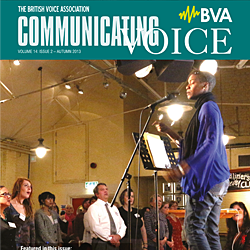 our newsletter
 free voice care leaflets & information – download here
 Help our work by donating while you shop